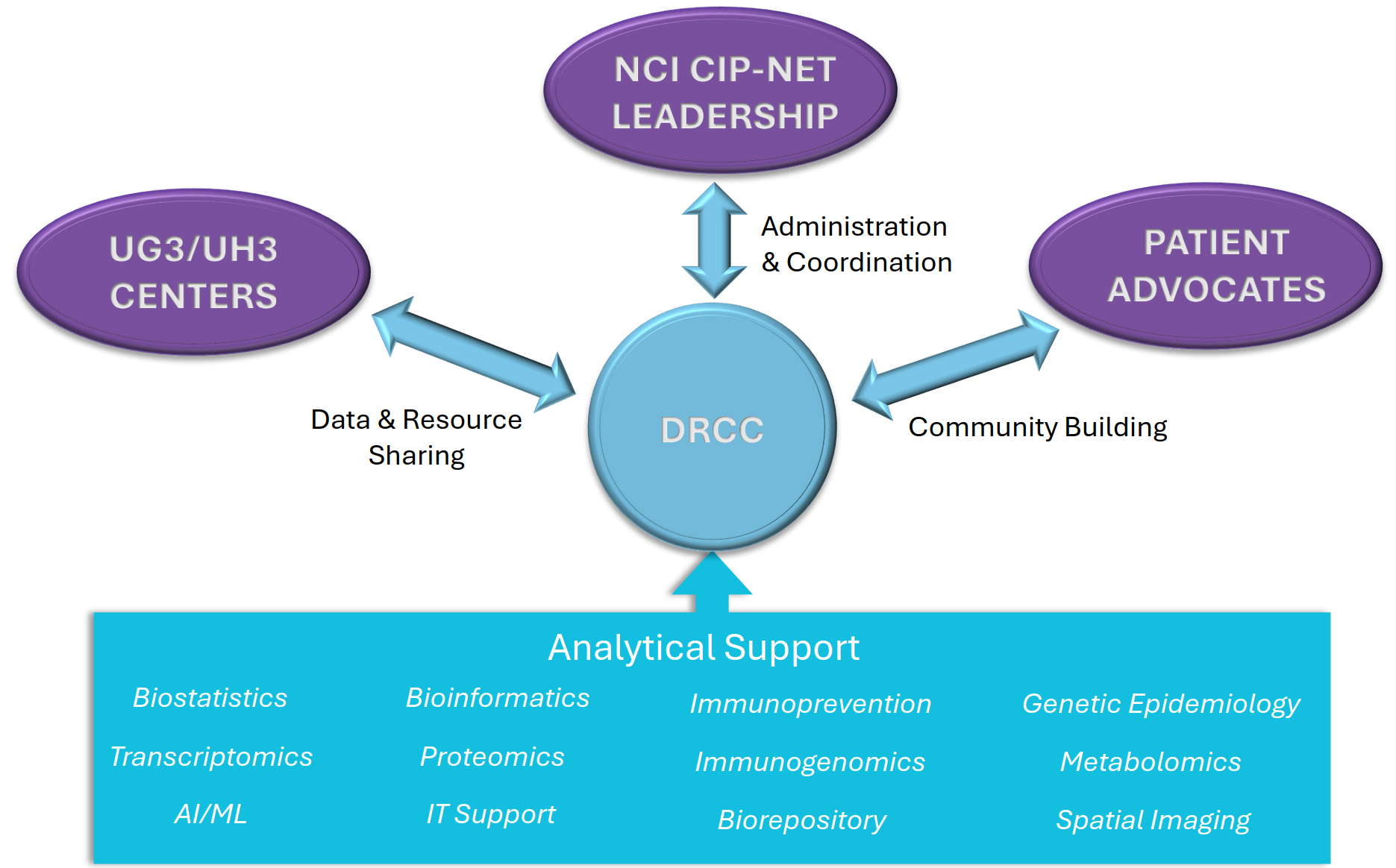
The Data and Resource Coordinating Center (DRCC) aims to catalyze collaboration across the CIP-Net and to manage, integrate, and disseminate the data and resources generated through the network. By leveraging cutting-edge, multidisciplinary team approaches, the DRCC will support CIP-Net in fostering a collaborative community of cancer immunoprevention researchers working collectively to understand the basic mechanisms of immunoprevention, discover novel immunoprevention strategies, and develop and test preclinical interventions.
The DRCC strategy focuses on boosting the productivity of CIP-Net investigators by fostering a collaborative research community, accelerating CIP-Net research by removing barriers to accessing analytics expertise, improving the interoperability and usability of CIP-Net data through best practices in data standards and harmonization, and unlocking the full potential of CIP-Net activities by sharing data and resources with the broader scientific community.
First, the DRCC will establish an effective administrative infrastructure and organizational process to coordinate CIP-Net activities, building on proven and continuously improving systems that currently support the coordination of NCI programs.
Second, CIP-Net data will be harmonized using standards interoperable with the broader cancer data ecosystem and made findable through a centralized virtual repository, leveraging an extensive track record and robust systems for collaborative data sharing and dissemination in consortium studies.
Third, the DRCC will provide multidisciplinary analytics expertise to support CIP-Net’s collaborative research, drawing on strengths in biostatistics, bioinformatics, and biomedical informatics from Roswell Park’s Department of Biostatistics & Bioinformatics.
Fourth, the DRCC will actively promote CIP-Net and work with stakeholders to build a research community that leverages a range of perspectives and approaches to address key scientific questions in immunoprevention.
Taken together, the DRCC, in close collaboration with CIP-Net stakeholders, will support highly effective and innovative translational studies that address critical unmet needs in cancer immunoprevention.
The main deliverables include administrative and organizational support to coordinate network activities and facilitate communication and collaboration (Aim 1); policies, workflows, and infrastructure to ensure that all resources generated by CIP-Net are harmonized using standards interoperable with the broader cancer data ecosystem and made findable through a centralized virtual repository; multidisciplinary analytics support to accelerate CIP-Net research progress, along with innovative solutions to address CIP-Net’s evolving needs (Aim 2); and community-building and outreach efforts to support immunoprevention research, integrate patient advocates into CIP-Net, and coordinate career development opportunities for early-career scientists (Aim 3).