
Developing a Novel Agonist of CD137 for Cancer Immunoprevention
PI: Haval Shirwan, MPI: Esma Yolcu
Institutions: University of Missouri-Columbia
Project Number: UG3CA290305
The main objective of Drs. Shirwan and Yolcu's cancer research program is to develop a universal cancer prevention strategy by training the immune system to monitor the body for and eliminate cancerous cells before cancer can develop, i.e. cancer immunoprevention. They have developed a recombinant protein, SA-4-1BBL, and demonstrated that, as a single agent, it prevents the development of various tumor types in preclinical models. The primary objective of this UG3/UH3 project is to elucidate mechanistic underlying of SA-4-1BBL-driven immunoprevention and validate it its efficacy in clinically-relevant mouse lung cancer models as a prelude to clinical translation for two high-risk cohorts; i) a strong smoking history with high-risk lung nodules detected on a low-dose screening computed tomography scan, and ii) a previously resected primary lung cancer with high risk of developing second primary lung cancer.
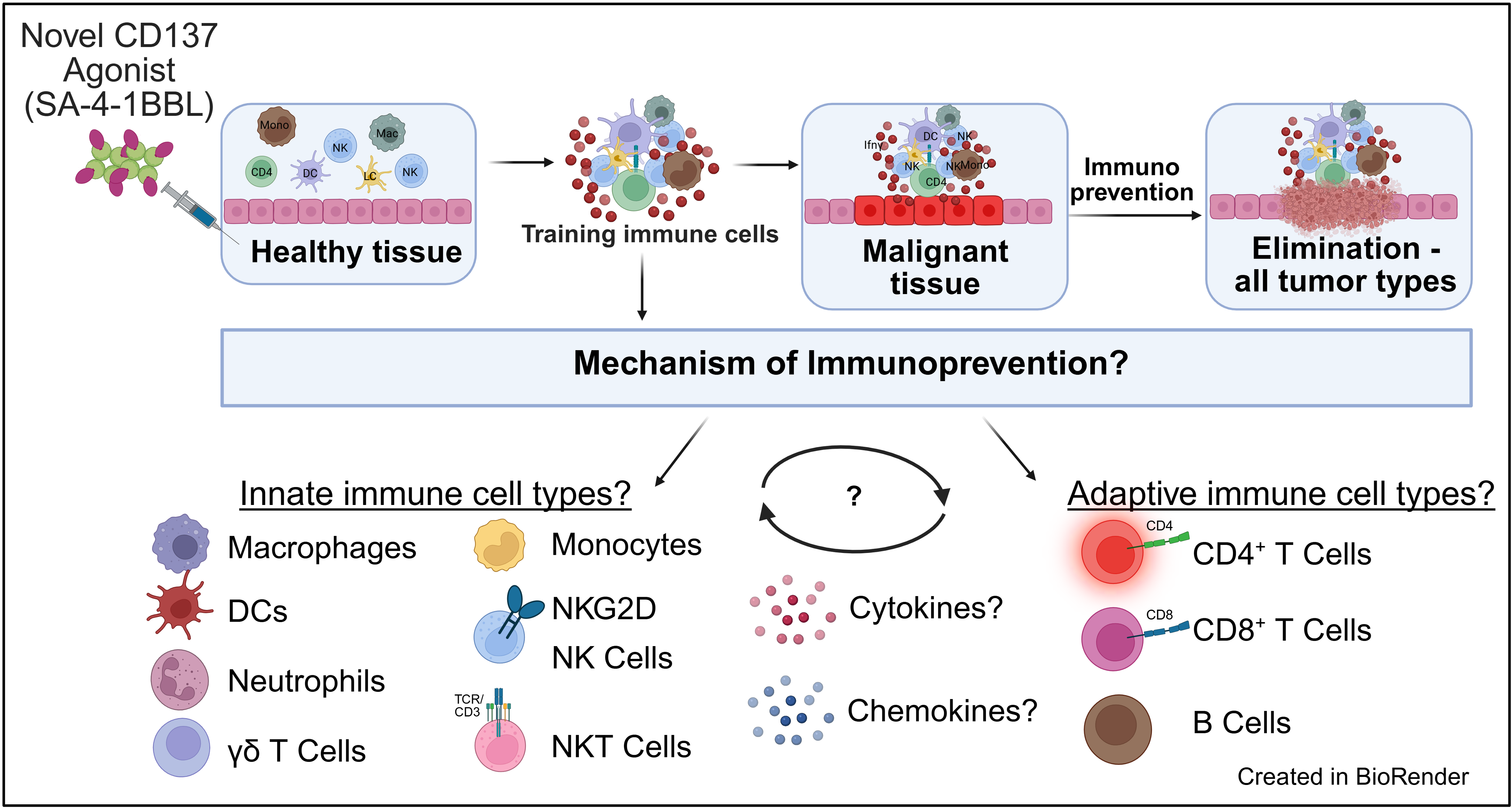
Specific Aims of the project are:
Scientific Focus within CIP-Net
Elucidating the mechanisms by which SA-4-1BBL trains the immune system to eliminate emerging cancer cells and validating its cancer immunoprevention efficacy in clinically relevant cancer models directly aligns with the CIP-Net’s mission of developing effective approaches for cancer immunoprevention and interception.
Public Health Relevance
The immune system is a critical defense mechanism not only against infections, but also against cancer, as it continually surveys the body for and eliminates emerging malignant cells. Indeed, cancer arises when it evades or suppresses this immune surveillance through diverse mechanisms. Revitalizing a failed immune system to treat established cancer faces major challenges, including the need to tailor therapies to tumor type as well as limitations in efficacy, safety, and high cost. Thus, training the immune system in individuals at high risk of developing cancer as a universal, tumor-agnostic preventive approach has the potential to overcome key barriers to therapeutic immunotherapy.
Specific Aims of the project are:
- Aim 1. Identify immune pathways targeted by the mouse (m)SA-4-1BBL (UG3).
- Aim 2. Test mSA-4-1BBL efficacy for cancer immunoprevention in a tobacco carcinogen-induced lung tumor model (UG3/UH3).
- Aim 3. Generate a human (h)SA-4-1BBL molecule and evaluate its lung cancer immunoprevention efficacy in 4-1BB receptor humanized mice (UH3).
- Aim 4. Evaluate the immunoprevention efficacy of hSA-4-1BBL in a humanized mouse model of patient-derived lung cancer.
- Validating SA-4-1BBL as an effective immunoprevention agent will pave the way for its clinical development for individuals at high risk of cancer.
Scientific Focus within CIP-Net
Elucidating the mechanisms by which SA-4-1BBL trains the immune system to eliminate emerging cancer cells and validating its cancer immunoprevention efficacy in clinically relevant cancer models directly aligns with the CIP-Net’s mission of developing effective approaches for cancer immunoprevention and interception.
Public Health Relevance
The immune system is a critical defense mechanism not only against infections, but also against cancer, as it continually surveys the body for and eliminates emerging malignant cells. Indeed, cancer arises when it evades or suppresses this immune surveillance through diverse mechanisms. Revitalizing a failed immune system to treat established cancer faces major challenges, including the need to tailor therapies to tumor type as well as limitations in efficacy, safety, and high cost. Thus, training the immune system in individuals at high risk of developing cancer as a universal, tumor-agnostic preventive approach has the potential to overcome key barriers to therapeutic immunotherapy.





Feyza Nur Arguc

Yongyong Li, PhD

Yichen Wang, PhD

Tyler Verburg