Non-melanoma skin cancer (NMSC) is one of the most common malignancies worldwide and represents a major public health burden. Chronic exposure to solar ultraviolet (sUV) radiation is a primary driver of keratinocytic carcinogenesis, partly through inducing inflammation and creating an immune-suppressive cutaneous microenvironment. Although immune checkpoint blockade has transformed cancer therapy, its potential for cancer immunoprevention remains largely unexplored.
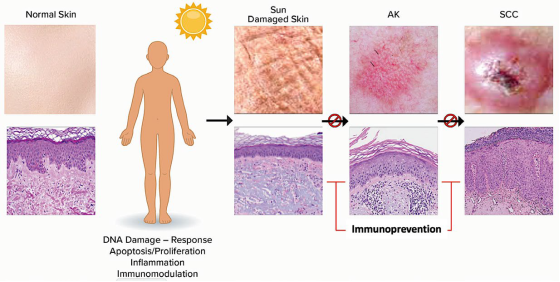
Recent work from our laboratory shows that the immune checkpoint ligand PD-L1 is upregulated in epidermal keratinocytes following acute and chronic UV exposure. This finding suggests that UV-induced immune checkpoint regulation may serve as a target for preventing photocarcinogenesis. However, it is not yet known if additional UV-responsive immune-related markers are also induced early in skin carcinogenesis and whether they can be targeted for prevention interventions. Fig 1. 'Targeted Immunoprevention for Non-Melanoma Skin Cancer' UG3/UH3 Grant. In sun-exposed skin, topical immunoprevention harness innate and adaptive mechanisms targeting all stages of tumorigenic progression to cSCC. Top row: representative clinical images; Bottom row: H&E-stained skin sections.
This CIP-Net UG3 and UH3 project implements a comprehensive and translational research strategy to test the hypothesis that early overexpression of selected UV-responsive immune checkpoint proteins promotes immune suppression in sun-damaged skin and supports the progression toward NMSC. These pathways may therefore represent new targets for preventing cutaneous squamous cell carcinoma (cSCC) and basal cell carcinoma (BCC).
UG3 Phase (Aim 1):
Use matched human skin samples, including sun-protected skin, sun-damaged skin, actinic keratoses (AK), cSCC, and BCC, and perform transcriptomic profiling and immunohistochemistry to identify immune checkpoint proteins that are upregulated early in the skin carcinogenesis process.
UG3 Milestones:
Define 2-3 immune checkpoint proteins that are upregulated in keratinocytes of sun-damaged skin or AK as well as overexpressed in cSCC tumor cells (keratinocytic origin)
Confirm these targets at the protein level using immunohistochemistry.
UH3 Phase (Aim 2):
Confirm that these human targets are also upregulated early in mouse skin tumorigenic progression, can affect cellular responses to UV stress in keratinocytes in culture, and can influence cutaneous responses to UV and photocarcinogensis in a transgenic mouse model.
UH3 Milestones:
Validate immune checkpoint protein candidates to be UV responsive in mouse skin
Determine UV-inducible signaling/phenotypic responses to keratinocytic knockout (genetic deletion) of these immune checkpoint proteins in vitro and in vivo
Screen compound libraries to discover and characterize small molecules targeting these immune checkpoints
Validate previous IHC findings using clinically-relevant multiplex staining of the human samples
Impact:
This project will identify novel molecular immune biomarkers that define the earliest steps of keratinocytic carcinogenesis. By targeting UV-induced immune checkpoint pathways before malignant transformation occurs, the proposed work will advance immunoprevention as a new strategy for reducing the morbidity and mortality associated with cSCC and BCC. The results have strong potential to generate meaningful translational benefits for patients at elevated risk of NMSC.