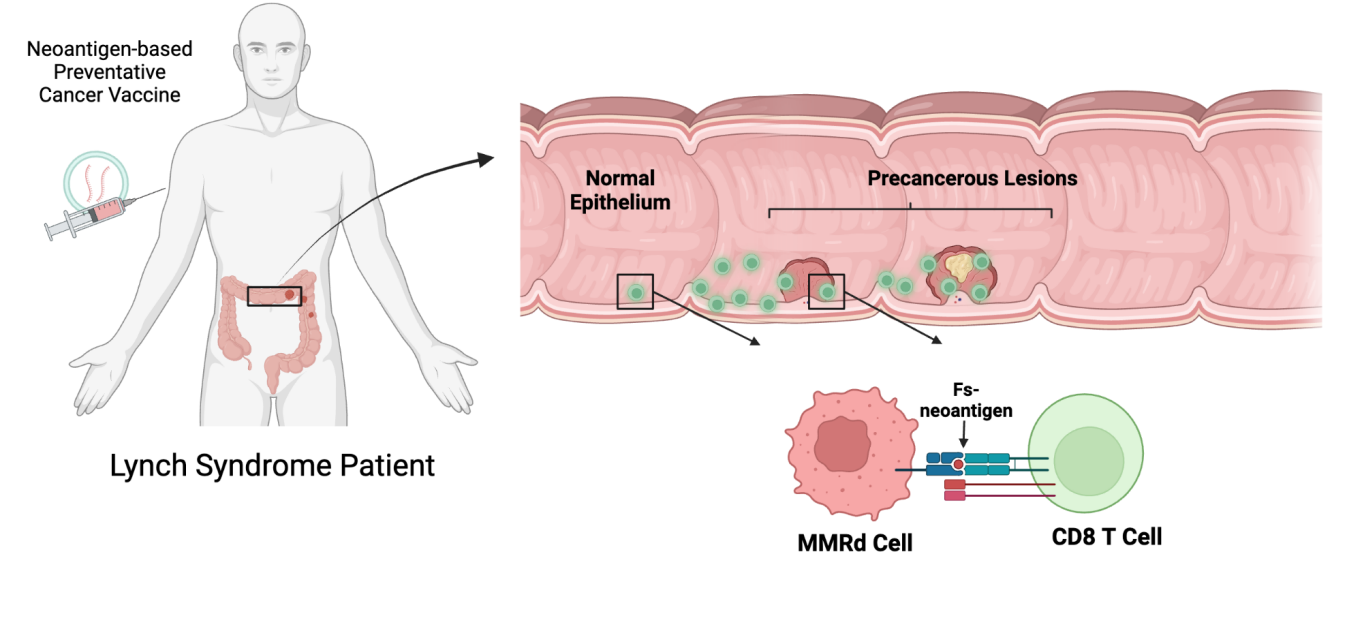
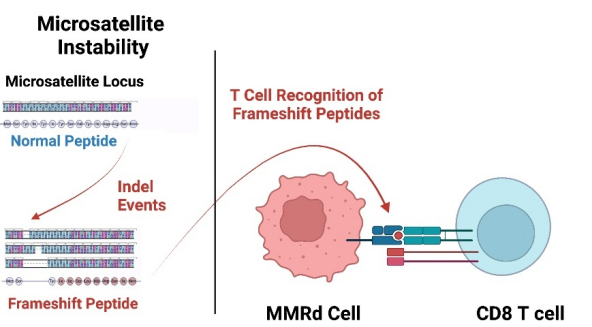
Lynch Syndrome (LS) provides a unique human model for advancing cancer immunoprevention. LS is caused by germline impairment of the DNA mismatch repair (MMR) pathway, leading to microsatellite instability (MSI-H), a high frameshift mutational load, and abundant neoantigen expression. These features generate strong baseline immune visibility and underlie the clinical responsiveness of MSI-H tumors to immune checkpoint inhibitors (CPI).
Prior work from the Bhardwaj group has shown that frameshift (fs) mutations produce neoantigens with properties that distinguish them from point mutations, including major divergence from self, shared expression in MSI-H CRC tumors across patients, and the ability to elicit circulating fs-neoantigen–reactive CD8⁺ T cells.
Premalignant LS lesions demonstrate dense T cell infiltration and expression of both inflammatory cytokines and immune checkpoints, suggesting that the immune system recognizes abnormal antigenic events at the earliest stages of tumor evolution. This environment is ideally suited for cancer interception strategies. They hypothesize that high-quality shared neoantigens and a functional T cell repertoire capable of trafficking to and clearing MMR-deficient lesions are central determinants that restrain progression from precancerous polyps to colorectal cancer in LS.
The goal of this CIP-Net UG3/UH3 project is to define the neoantigen and T cell features that govern immune surveillance, immune escape, and opportunities for immunologic intervention in LS.
UG3 Phase:
Identification of neoantigens expressed in premalignant colon polyps of Lynch Syndrome patients. This phase focuses on mapping both novel and shared frameshift-derived neoantigens present in precancerous colorectal lesions from individuals with Lynch Syndrome. The goal is to identify antigens with strong potential for future immunoprevention strategies.
Identification of fs-specific TCRs capable of recognizing quality fs-neoantigens. Using barcoded peptide–MHC tetramers and single-cell RNA/TCR sequencing, this work will validate immunogenic neoantigens and define the repertoire of frameshift-specific T cell receptors (TCRs), including both private and shared receptors detectable in peripheral blood.
Modified from Mestrallet and Brown et al. Front Immunol. 2023 UH3 Phase:
Validate fs-neoantigen expression and tissue trafficking of fs-specific TCRs in a separate validation cohort.
This phase will evaluate whether fs-specific TCRs localize to and interact with target lesions in vivo, thereby confirming their biological relevance and functional engagement.
Assess the influence of prior MSI-H cancer on shared fs-neoantigen repertoire and T cell recognition in subsequent colon lesions.
The study will assess whether previous exposure to shared frameshift neoantigens in earlier MSI-H cancers influences the antigenic landscape and immune surveillance of subsequent colorectal lesions, functioning as a potential form of “pre-vaccination.”
Assess fs-specific T cell exhaustion and co-localization with immunosuppressive hubs in advanced precancerous lesions.
Through bulk and single-cell RNA sequencing, spatial transcriptomics, and multiplex immunohistochemistry, this aim will characterize T cell exhaustion states and their spatial association with immunosuppressive microenvironmental hubs, identifying key pathways and targets for future interception approaches.
By integrating neoantigen discovery, TCR repertoire mapping, and high-resolution profiling of the premalignant microenvironment, this project is expected to elucidate fundamental mechanisms governing immune control and immune escape in Lynch Syndrome. The resulting insights may inform the development of next-generation immunoprevention strategies, including neoantigen-based vaccines and combination interventions designed to enhance early immune surveillance and prevent cancer progression.
vaccines and rational combination interventions that strengthen early immune surveillance and prevent cancer development.
Public Health Relevance
Lynch syndrome (LS) is a hereditary cancer predisposition syndrome caused by defects in the DNA mismatch repair (MMR) pathway and is associated with a high burden of shared frameshift neoantigens and increased T cell infiltration, which contribute to improved responses to immune checkpoint inhibitor therapy. The project will test the hypothesis that high-quality shared neoantigen expression, together with a functional T cell repertoire capable of trafficking to and clearing MMR-deficient lesions, limits the progression of premalignant colorectal polyps to invasive cancer in LS. To address this, the project will (i) characterize shared and novel frameshift neoantigens in precancerous colorectal polyps, (ii) identify and track neoantigen-specific T cell receptors, and (iii) define microenvironmental features that promote tumor progression to inform prevention and interception strategies.