
Engineered probiotic bacteria for colorectal cancer immunoprevention and interception
PI: Nicholas Arpaia, MPI: Tal Danino
Institutions: Columbia University
Project Number: UG3CA301294
Synthetic biology is ushering in a new era of medicine by enabling the genetic programming of living cells for therapeutic applications. A major focus of this field is the engineering of bacteria as in vivo therapeutic delivery systems capable of selectively localizing to diseased tissues and releasing diagnostic or therapeutic payloads. Colorectal cancer (CRC) initiation and progression are strongly shaped by interactions between the intestinal microbiota and the mucosal immune system, making these interactions attractive targets for immunoprevention and interception strategies using engineered probiotics.
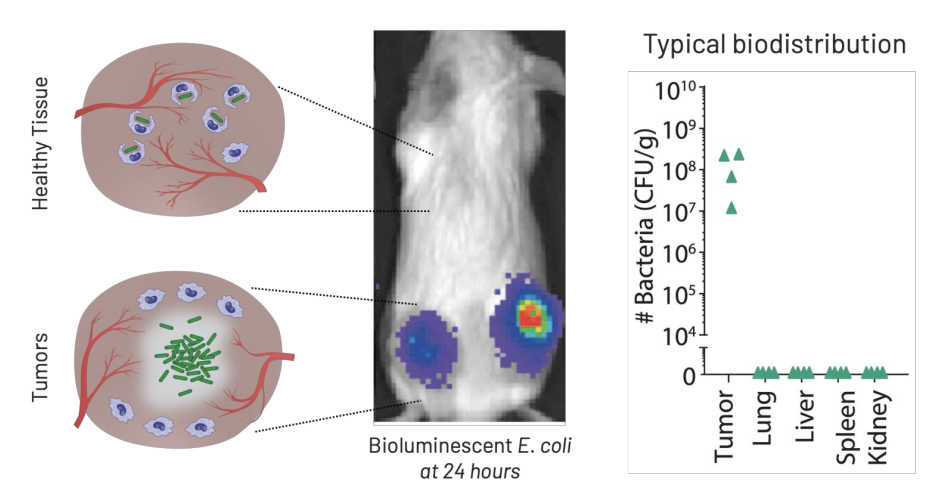
The Arpaia and Danino labs have demonstrated that the probiotic bacterium Escherichia coli Nissle 1917 (EcN), when administered orally, selectively colonizes colorectal polyps and adenomas compared to normal intestinal tissue in murine models, and preferentially colonizes tumors in patients with CRC. They have further shown that engineered EcN strains can produce diagnostic and therapeutic molecules in models of early-stage CRC. Building on these findings, this UG3/UH3 project seeks to advance a modular, stage-specific bacterial immunotherapy platform for CRC prevention and interception.
During the UG3 Phase, a tamoxifen-inducible, biallelic adenomatous polyposis coli (APC) deletion mouse model (Apc^Fl/Fl^Cdx2-CreERT2^) will be utilized to define the dynamics of EcN colonization across stages of CRC development and to characterize associated immune cell infiltration and activation.
Specific Aims (UG3 Phase)
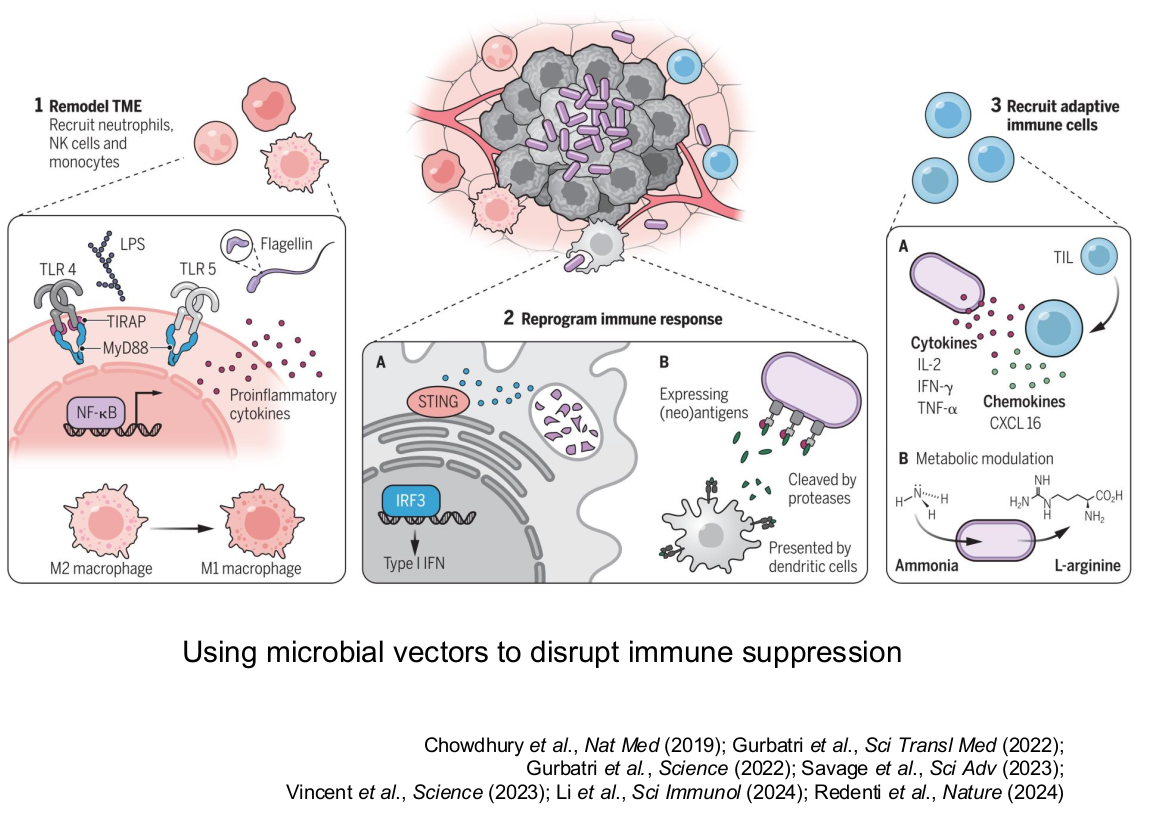
In the UH3 Phase, these insights will be translated into the rational design of immunotherapeutic EcN strains for CRC prevention and interception. For prevention studies, EcN strains expressing inflammatory payloads (e.g., GM-CSF and IFNγ) will be engineered and administered prior to APC deletion to evaluate their ability to prevent neoplastic lesion development. For interception studies, EcN strains expressing immunomodulatory payloads, including GM-CSF and blocking nanobodies targeting CTLA-4 and PD-L1, will be delivered following confirmation of precancerous polyp formation. The durability and functional relevance of induced immune responses will be assessed by challenging treated mice with organoids representing progressively advanced stages of carcinogenesis.
Specific Aims (UH3 Phase)
Outcome: Will determine effective engineered probiotics for immune prevention and interception.
Future work: Develop clinic-ready strains with antibiotic resistance genes removed, further assess toxicity and safety, and work toward a clinical trial.
The Arpaia and Danino labs have demonstrated that the probiotic bacterium Escherichia coli Nissle 1917 (EcN), when administered orally, selectively colonizes colorectal polyps and adenomas compared to normal intestinal tissue in murine models, and preferentially colonizes tumors in patients with CRC. They have further shown that engineered EcN strains can produce diagnostic and therapeutic molecules in models of early-stage CRC. Building on these findings, this UG3/UH3 project seeks to advance a modular, stage-specific bacterial immunotherapy platform for CRC prevention and interception.
During the UG3 Phase, a tamoxifen-inducible, biallelic adenomatous polyposis coli (APC) deletion mouse model (Apc^Fl/Fl^Cdx2-CreERT2^) will be utilized to define the dynamics of EcN colonization across stages of CRC development and to characterize associated immune cell infiltration and activation.
Specific Aims (UG3 Phase)
- Construct a library of violacein-producing EcN to identify multiple stages of CRC – from precancerous adenoma to invasive carcinoma.
- Determine the kinetics of adenoma progression following biallelic deletion of Apc and assess the ability for EcN to colonize precancerous and cancerous lesions.
- Characterize the immune cell repertoire of EcN-colonized precancerous lesions by spatial transcriptomics.
In the UH3 Phase, these insights will be translated into the rational design of immunotherapeutic EcN strains for CRC prevention and interception. For prevention studies, EcN strains expressing inflammatory payloads (e.g., GM-CSF and IFNγ) will be engineered and administered prior to APC deletion to evaluate their ability to prevent neoplastic lesion development. For interception studies, EcN strains expressing immunomodulatory payloads, including GM-CSF and blocking nanobodies targeting CTLA-4 and PD-L1, will be delivered following confirmation of precancerous polyp formation. The durability and functional relevance of induced immune responses will be assessed by challenging treated mice with organoids representing progressively advanced stages of carcinogenesis.
Specific Aims (UH3 Phase)
- Design and engineer immunotherapeutic bacteria for the prevention of CRC.
- Design and engineer immunotherapeutic bacteria to intercept the oncogenic progression of CRC.
- Characterize and examine the durability of the immune response elicited by engineered bacteria.
Outcome: Will determine effective engineered probiotics for immune prevention and interception.
Future work: Develop clinic-ready strains with antibiotic resistance genes removed, further assess toxicity and safety, and work toward a clinical trial.



Zaofeng Yang, PhD, Associate Research Scientist

Kenia De Los Santos, Research Staff Associate III

Dylan Mariuzza, PhD candidate

Ed Ballister, PhD, Associate Research Scientist

Jade Pereira de Andrade Peres, PhD, Senior Staff Associate III, Director of Research Operations

Courtney Coker, Staff Associate

Filippo Liguori, PhD, Postdoc

Zeren Sheng, PhD candidate

Shunyu Huang, PhD candidate

Hannah Kim, Research Assistant